
For Maestro Cloud pricing in 2026, use the service’s current published rates or a written quote that covers your actual workload. Separate hosted execution charges from the engineering work needed to prepare builds, maintain YAML flows, and investigate failures. Start with Maestro Deck’s free local desktop runner when you need to write and debug tests; paid cloud execution is optional, not a requirement for local use.
- Maestro Cloud pricing needs a current rate and a defined workload, not an assumed monthly total.
- Maestro Deck is best for developers who want a free local runner and inspector for Maestro YAML flows.
- Compare hosted execution against local testing, CI requirements, and the environments your release needs.
- Confirm billing units, execution limits, and retry treatment before committing to hosted runs.
How much does Maestro Cloud cost in 2026?
Base your budget on Maestro Cloud’s current terms and your planned execution workload. Do not substitute another provider’s pricing, a local runner’s license, or an old comparison article for the service’s current offer.
The names need separating before the numbers do. Maestro is the framework associated with the YAML flows discussed here. Maestro Cloud and Maestro Deck Cloud are distinct services; this guide does not imply affiliation between them. The latter’s pricing page applies to that service, not to Maestro Cloud.
Use this breakdown when evaluating a cloud proposal:
| Budget component | What to establish | Why it belongs in your decision |
|---|---|---|
| Hosted execution | The billing unit and what constitutes a charged execution | A rate means little without a defined unit |
| Included usage | Any allowance and its measurement period | Included usage changes how you interpret the headline offer |
| Additional usage | How execution beyond the allowance is handled | Your release workload needs an explicit treatment |
| Execution capacity | The simultaneous execution limit and queue behavior | Capacity affects how tests fit into your release workflow |
| Engineering work | Build preparation, flow maintenance, and failure investigation | A hosted service does not remove these tasks |
These are questions to resolve, not assertions about Maestro Cloud’s billing model. Read the current terms against each row before approving a budget.
Why this matters
A pricing search often combines different decisions: how to write tests, where to execute them, and how to automate them in CI. You can make those decisions separately. Paying for hosted execution does not automatically make a test reliable or a failure easier to diagnose.
For a 2026 release workflow, define the job before choosing the service. A developer debugging a changed screen has a different need from a pipeline running release checks without someone at a desktop.
Buy hosted execution to solve an execution requirement, not to compensate for an undefined test suite. First establish the flows, application state, and expected results that your team will maintain.
Local testing and hosted execution solve different problems
Maestro Deck provides a free, source-available desktop runner and inspector for writing and executing Maestro YAML flows across iOS, Android, and web apps. Local use does not require a cloud account. Its cloud execution is a separate, optional step when you need hosted runs or CI execution.
Compare the workflows without assuming that every hosted service offers identical environments or billing terms:
| Workflow | Best for | Practical advantage | Trade-off |
|---|---|---|---|
| Local desktop execution | Developers writing and debugging flows | Keep the edit, inspect, and rerun loop local | You remain responsible for the local execution environment |
| Hosted execution | Teams needing execution outside a developer’s desktop | Move the execution task into a hosted workflow | You must evaluate service terms, environment coverage, and execution limits |
The local runner is not a substitute for every hosted requirement. Equally, a cloud account is not a prerequisite for learning the flow format or inspecting a failing interaction.
Choose the workflow by the task. Keep interactive diagnosis close to the developer. Evaluate hosted execution when the release process needs an execution environment independent of that developer’s machine.
Source-available does not mean open source
Source-available describes access to source code under the applicable license. It does not, by itself, establish the permissions associated with an open-source license.
Review the license before redistributing code, modifying it for organizational use, or incorporating it into another product. Do not infer those permissions from the fact that a repository can be read.
Why your cloud testing budget varies
Your 2026 budget should describe the work you intend to execute. Whether a particular workload dimension changes the invoice depends on the provider’s current terms; establish that relationship explicitly.
- Execution scope: Identify which YAML flows belong in the hosted suite. Separate release-blocking checks from exploratory or unfinished work.
- Trigger policy: Decide whether execution follows pull requests, merges, scheduled jobs, or release candidates. Write down the policy rather than leaving it to individual developers.
- Environment coverage: Specify the operating systems and browser environments you actually need. Confirm simulator, emulator, browser, and physical-device requirements separately.
- Retry policy: Define when a failed execution qualifies for another attempt. Ask how the service treats those attempts for billing purposes.
- Execution capacity: Establish whether jobs must run simultaneously or can wait. Verify the capacity included in the offer rather than assuming that hosted means unlimited.
- Operational requirements: Identify test-data handling, access controls, and failure evidence that your organization needs. Confirm which requirements the service documents and which require further agreement.
Do not interpret these factors as a published Maestro Cloud rate card. They define the workload and contractual questions that make a rate card useful.
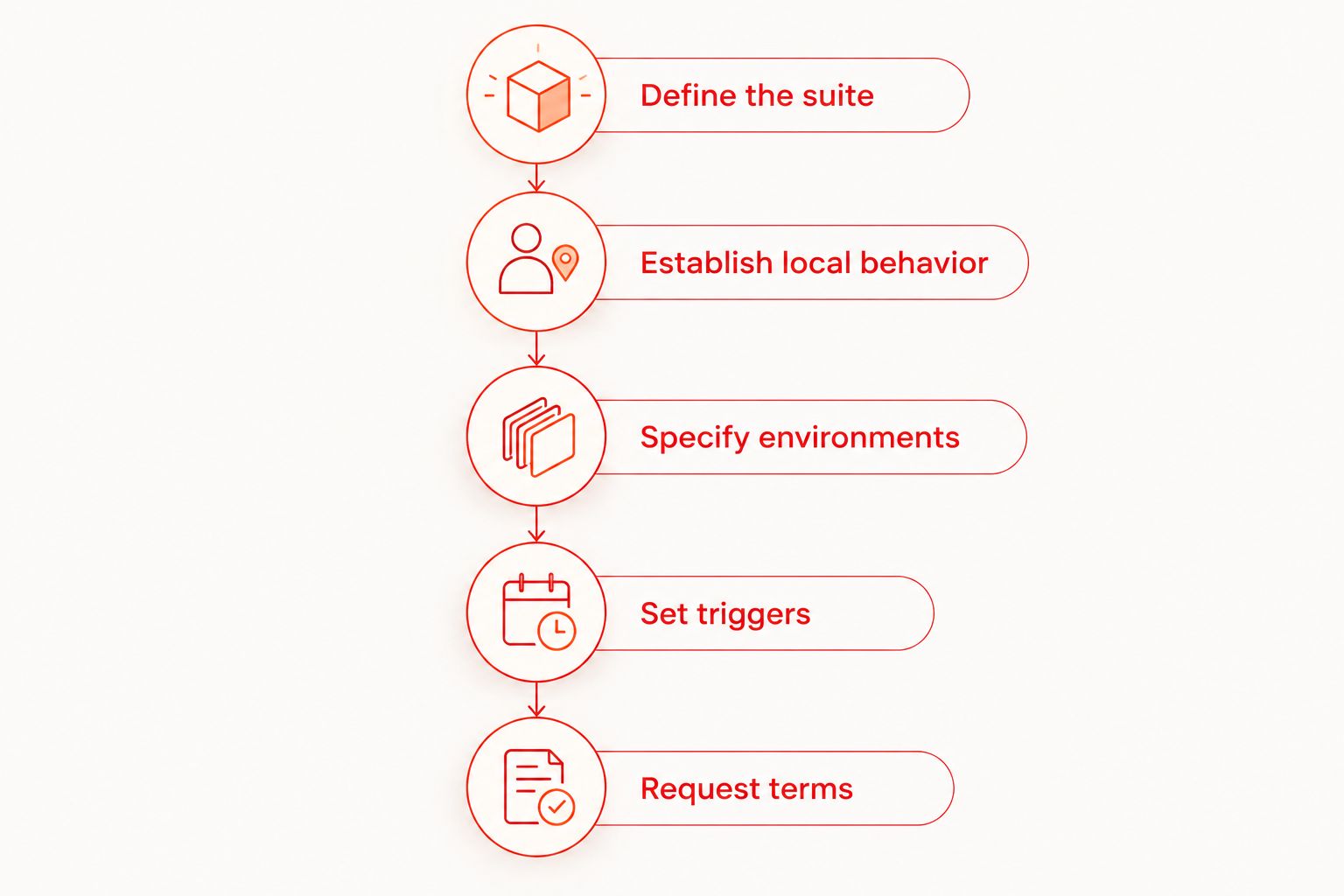
Build a workload before requesting a quote
A useful pricing request describes executable work. It does not stop at the number of developers on the team.
Define the suite
List the release-critical journeys your app must complete. For each journey, record the starting state, the actions the flow performs, and the result that proves success.
Use your application’s real behavior. A flow that reaches a screen without checking the intended result leaves the release decision ambiguous. Keep test expectations specific enough that another developer can explain why the flow passed.
Establish local behavior
Run the selected flows locally before using them as the basis for a hosted evaluation. Resolve unclear selectors, missing test data, and undocumented setup requirements.
Record execution duration from your own environment as a planning input, not as a promise about hosted performance. Different execution environments require their own measurements. Do not turn a local observation into a competitor speed claim.
Specify environments
Write down the required platform and environment for each journey. Keep simulator and emulator coverage distinct from physical-device coverage.
An iOS simulator requirement does not establish a requirement for a physical iPhone. An Android emulator run does not prove execution on a physical Android device. Ask providers to confirm the exact environment rather than accepting the word device without qualification.
Set triggers
Choose the event that starts each suite. Keep the trigger policy in version-controlled workflow configuration or another maintained engineering record.
Document what happens after failure. A release-blocking check needs an owner and a decision path; otherwise, the team can accumulate executions without a consistent release signal.
Request terms
Send the suite scope, environment requirements, trigger policy, and capacity needs together. Ask for the billing unit, included usage, additional-usage treatment, retry treatment, and any applicable limits in writing.
Compare the response against your requirements. A proposal that leaves an essential execution requirement unresolved is not ready for a purchasing decision.
Compare offers using the same workload
For a 2026 comparison, send each provider the same execution requirements. Otherwise, you are comparing differently scoped proposals rather than equivalent services.
Keep a short decision record. Include the required environments, the execution policy, the failure evidence you need, and the terms each provider confirms. Mark unresolved questions as unresolved instead of filling them with assumptions.
If BrowserStack is on your shortlist, use its current official documentation and proposal for its capabilities and terms. Do the same for Maestro Cloud. Do not assume that either service matches the other’s environment coverage, execution model, or reporting.
Read the distinction between local editing and hosted runs before treating a local desktop tool and a hosted service as interchangeable purchases.
Evaluate failure handling, not just successful runs
A successful flow shows that a particular journey completed under the tested conditions. Your evaluation also needs a deliberate failure that a developer can investigate.
Use a controlled change in a test branch. Check whether the resulting evidence lets the responsible developer identify the failing step and reproduce the issue. Evaluate only the artifacts and diagnostic capabilities the provider actually documents or demonstrates.
This is an evaluation procedure, not a claim that a particular provider supplies specific artifacts. Ask for confirmation before making them a release dependency.
When should you move local flows into CI?
Move stable flows into CI when they have explicit setup requirements, clear assertions, and a defined failure owner. The trigger should support a release decision rather than merely create another job.
Keep local debugging available after adding hosted runs. CI execution and interactive inspection serve different purposes; neither removes the need for the other.
If you choose Maestro Deck for local E2E testing, evaluate its optional cloud execution only when the workflow needs it. Review current terms before signing up for paid runs. Local use remains separate from that decision.
Review cloud execution terms
Check the current offer before adding optional hosted execution to your release workflow.
Does running tests locally remove all testing work?
Local execution removes the need to purchase hosted execution for that local run. It does not remove build preparation, environment setup, test maintenance, or failure investigation.
Assign those responsibilities before adding release gates. A team needs to know who repairs a broken flow, who maintains test accounts, and who decides whether a failure blocks shipping.
Is a simulator the same as a physical device?
A simulator is not a physical device, and an emulator is not a physical device. Describe your required environment precisely when evaluating hosted coverage.
Choose coverage based on the behavior you need to validate. Do not claim physical-device testing from documentation that only establishes simulator or emulator execution.
FAQ
Where should I check Maestro Cloud pricing in 2026?
Check Maestro Cloud’s current official pricing information or request a written quote. Confirm that the terms cover your intended workload, environments, and execution requirements.
Is Maestro Deck the same as the Maestro framework?
Maestro Deck is a desktop runner and inspector for Maestro YAML flows, not the Maestro framework itself. Distinguish the framework, the desktop application, and any hosted execution service when evaluating your workflow.
Do I need a cloud account to run flows locally?
Local desktop use does not require a cloud account. Treat cloud sign-up and paid hosted execution as separate decisions.
Does a cloud testing subscription remove test maintenance?
Hosted execution does not remove test maintenance. Your team still needs to maintain flows, application state, test data, and failure ownership.
Should I move every YAML flow into CI immediately?
Move flows into CI after their setup requirements, assertions, and failure ownership are clear. Keep unfinished or unreliable checks out of release-blocking gates until you resolve their behavior.
Does simulator support prove physical-device support?
Simulator support does not prove physical-device support. Ask for the exact execution environment and confirm physical-device availability separately when your tests require it.
Is source-available software automatically open source?
Source-available software is not automatically open source. Read the applicable license to establish permissions for use, modification, and redistribution.
One last thing
Ask what happens to a failed run before asking how to run more tests. Retry treatment, failure evidence, and ownership belong in the same evaluation as execution rates.
For your 2026 purchasing decision, bring a small, understood release suite to the provider. A defined workload and written terms give you a usable budget; an isolated headline rate does not.